
Warehouse storage has a habit of filling up faster than anyone plans for. One minute everything’s running smoothly, the next you’re juggling pallets, blocking aisles and wondering how much more you can squeeze in. When floor space gets tight and pallet volumes are increasing, the way you store stock matters.
Traditional storage systems like selective pallet racking do a good job when you need quick access to different products. But if you’re storing large volumes of the same stock, all those aisles can chew up valuable space. That’s where drive-in pallet racking comes in.
Drive-in racking lets you store more stock in the same warehouse footprint. Storing pallets deeper and limiting access aisles can be a game-changer. Of course, it’s not a one-size-fits-all solution. Access, stock rotation and forklift movement all need to line up.
In this guide, we’ll walk through how drive-in pallet racking works. We’ll look at when it makes sense to use it, so you can work out whether drive-in racking is right for your warehouse.
What is drive-in racking?
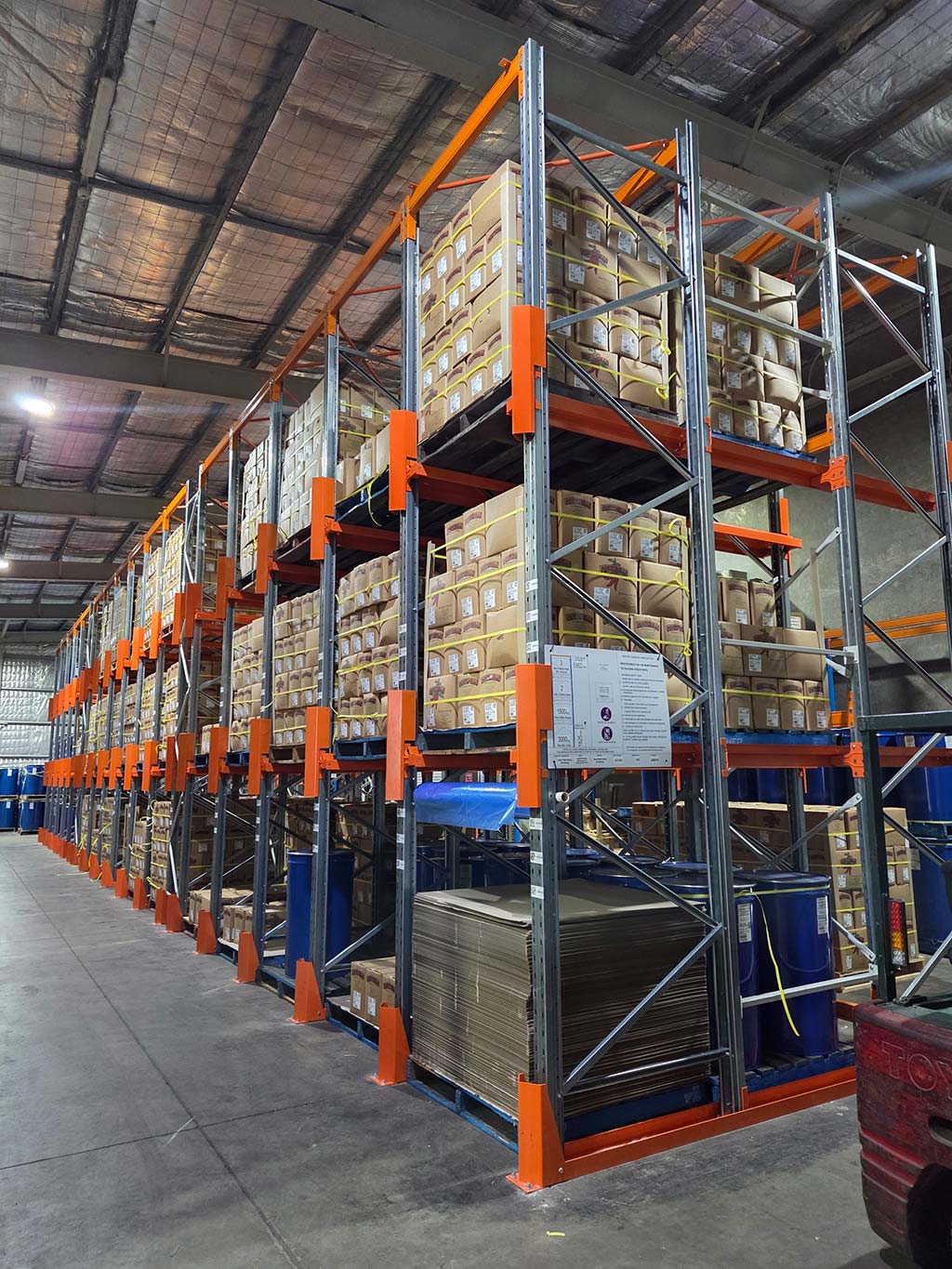
Drive-in racking is a high-density inventory management system in which forklifts drive into deep lanes to store pallets, reducing the number of aisles needed in a warehouse.
Drive-in vs selective racking
Selective pallet racking uses beams to hold pallets at the front of each bay. Drive-in pallet racking uses steel forklift guide rails mounted to the uprights. Pallets sit on this guide rail system, which supports them from both sides. With fewer narrow aisles and deeper storage lanes, you can store significantly more pallets in the same floor area.
Drive-in pallet racking systems work best when you’re storing large quantities of a smaller range of products. You trade a bit of pallet choice for much better storage capacity, and for many warehouses, that’s a trade worth making.
How drive-in racking works?
Drive-in racking is a LIFO (last-in, first-out) racking system. Forklifts load pallets into a lane by driving into the racking and placing pallets onto the horizontal rails. That means they load from the back and work forward. When it’s time to retrieve stock, the process runs in reverse, with the most recently loaded pallet coming out first.
Drive-in pallet racking uses a dedicated lane for a single product type and pallet size. Floor-mounted forklift guide rails help forklifts line up correctly, while the racking structure supports the load throughout the lane.
Because forklifts are operating inside the racking, good design and proper protection are key. Column guards, pallet deflectors and correct clearances can all keep the system safe.
Drive-in, LIFO racking systems suit operations that move stock in steady, predictable volumes.

Pros and cons of drive-in racking
Drive-in racking can be a smart move for the right warehouse, but it comes with trade-offs. Laying them out clearly makes it easier to see whether they suit your operation.
Pros
- High storage density: By removing multiple access aisles, you can store more pallets in the same footprint.
- Cost-effective use of space: Drive-in pallet racking increases your storage space when expanding the building isn’t an option.
- Ideal for bulk storage: Drive-in racking is perfect for long-term storage of high-volume products with consistent pallet sizes.
- Simple, robust design: A practical cold storage racking solution and ideal for distribution centres and industrial environments.
- Custom layouts: Meet your inventory management needs with tailored options to suit pallet size, load weight and warehouse height.
Cons
- Limited access: LIFO systems like this mean you access pallets on a first-in, last-out basis.
- Not suitable for mixed SKUs: You’ll need to limit your item range within the same lane.
- Higher risk of forklift impact: Operators may drive into the racking structure.
- Slower access: If you frequently rotate stock or need to pick individual pallets, this will take longer.
Drive-in racking works when space efficiency is the priority, and your stock movement is predictable. If flexibility and fast access matter more, other storage solutions may be a better fit.
Is drive-in racking right for you?
Before committing to drive-in racking, it’s worth running through the following checklist. A few clear ticks or crosses here will usually point you in the right direction.
Drive-in racking is a good fit if:
- You store high volumes of the same product
- Your operation runs with a low SKU count
- Pallets are standardised in size and weight
- Stock turnover suits LIFO systems
- Warehouse space is tight, and storage density matters
- You’re operating a cold storage or bulk distribution centre
Drive-in racking may not suit you if:
- You need 100% pallet access
- Your warehouse handles many different SKUs per aisle
- Orders rely on frequent picking of individual pallets
- Stock rotation needs to follow FIFO instead of FILO
- Forklift access is already tight or highly congested
If most of your answers are mostly ticks on the ‘good fit’ side, drive-in racking can deliver serious gains in space and efficiency. If not, other high-density systems may give you better day-to-day performance.

Why choose Global Industrial’s drive-in pallet racking
Global Industrial has been supplying Australian warehouses with racking solutions for years, so we know what works. Our racking is engineered for Australian conditions, and we test it to the latest standards (AS 4084:2023 and FEM 10.2.07).
We know every warehouse is different, so we’ll work with you to design a system that fits your operation. Our APEX racking systems come with a lifetime structural warranty, so you know yours will last. On top of that, we offer nationwide supply and support. That means our experts are on hand to deliver and install your system properly.
Increase your warehouse storage
Drive-in racking can transform how your warehouse uses space. It’s a powerful solution for high-volume, low-SKU storage. It keeps pallets organised and accessible for forklift operators. And done properly, it delivers serious storage density and long-term value.
If you’re ready, get in touch with the team at Global Industrial. We can help you review your warehouse layout design for drive-in racking tailored to your warehouse.
FAQs
Q: What is the difference between drive-in and drive-through racking?
A: Drive-in racking is accessed from one side and follows a last-in, first-out (LIFO) approach. This makes it ideal for high-density storage of the same product. Drive-through racking is accessible from both ends. This allows pallets to be loaded from one side and unloaded from the other for better stock flow.
Q: Is drive-in racking safe for all forklift types?
A: Drive-in pallet racking is safe when matched to the right forklift and operated correctly. You can use reach trucks, counterbalance forklifts, and other suitable models. However, the system design must factor in aisle widths, clearances and operator training.
Q: Does drive-in racking follow LIFO or FIFO?
A: Drive-in racking operates on a last-in, first-out (LIFO) method. The last pallet loaded is the first one removed. This works well for fast-moving stock with consistent turnover. It may not suit operations that require strict stock rotation.
Get in touch with Global Industrial to see how our high-density drive-in racking can work for you. Contact Us Today